Practical guide
Five Phases in TCM: Generating, Controlling and Reversed Arrows
Read the arrow legend before the five phase names. Generating and controlling use different circuits; overacting keeps a controlling direction, while counter-restraint reverses it. Compare two original diagrams and solve six explained reading questions.
On this page
Start with the relation, then follow the arrow
A five-phase diagram can show the same five labels while telling you different relationships. First find its legend: generating, controlling, overacting or counter-restraint. Then read one directed pair. “Wood points to Earth” is not a complete interpretation until you know what that arrow represents.
In the 2022 WHO terminology book, 五行 (wǔ xíng) describes a traditional set of categories represented by wood, fire, earth, metal and water. The book lists “five phases” as a synonym for its English “five elements” headword. The labels belong to that theory; they are not a periodic-table inventory or a finding about your body.
This guide answers a diagram-reading question. It does not establish whether a person has a particular pattern or whether a treatment works. Keep a copy of the original diagram and its wording while comparing the labelled circuits below.
Source [1]: WHO (2022), WGM2 entries 28, 34–35; printed pages 3–4.
The same nodes form two different directed circuits
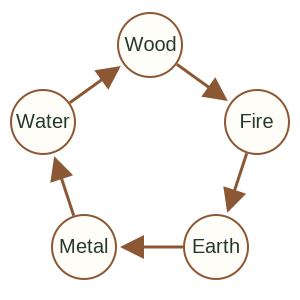
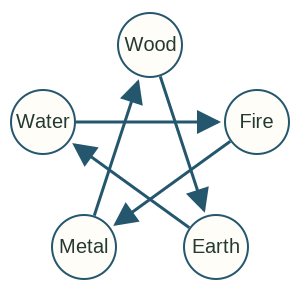
The brown generating circuit goes Wood → Fire → Earth → Metal → Water → Wood. The blue controlling circuit goes Wood → Earth → Water → Fire → Metal → Wood. Each has five arrows and returns to its starting node. Starting your reading at Water instead of Wood changes the written order, not the underlying directed relation.
For Wood, the immediate generating destination is Fire, whereas the immediate controlling destination is Earth. For Water, those destinations are Wood and Fire respectively. Do not infer the second circuit by reversing the first one: they connect different pairs.
Read the accessible text sequences under the images if an arrow intersection or small screen makes the picture harder to follow. The diagrams are original illustrations of the named traditional relations, not copied WHO figures or medical images.
Source [1]: WHO (2022), WGM2 entries 34–35; printed pages 3–4.
Separate direction from the strength or reversal of a relation
| Label and Chinese wording | Direction to inspect | Reading limit |
|---|---|---|
| Generating — 相生 (xiāng shēng) | Follow the generating circuit, such as Wood → Fire. | A supporting relation in the named traditional framework; not measured physical production. |
| Controlling — 相克 (xiāng kè) | Follow the controlling circuit, such as Wood → Earth. | A restraining relation; the arrow alone is not a disease claim. |
| Overacting — 相乘 (xiāng chéng) | Keep the controlling pair’s direction; the source describes excessive restraint. | Do not call every ordinary controlling arrow excessive. |
| Counter-restraint — 相侮 (xiāng wǔ) | Reverse a controlling pair, such as Earth → Wood rather than Wood → Earth. | Specify which controlling pair was reversed; not the reverse of any arbitrary arrow. |
On a phone, scroll inside the table. Keyboard readers can focus the table region and use the arrow keys.
A diagram that labels every arrow with one word loses these distinctions. Likewise, a thicker line cannot be assumed to mean overacting unless its legend actually says so. Record the label you can see and leave a missing legend unresolved.
The source’s overacting and counter-restraining entries distinguish excessive restraint from reversed restraint. They do not provide a numerical threshold, symptom checklist or measurement with which to decide either condition for a reader.
Source [1]: WHO (2022), WGM2 entries 35, 38–39; printed page 4.
Mother and child are relational labels here
The terminology book also uses mother and child wording for successive elements in the generating relationship. Fire is generated by Wood and generates Earth: relative to Fire, Wood is the mother and Earth is the child in that circuit. Fire can therefore be a child in one directed pair and a mother in another.
Write the pair before the role: Wood → Fire, therefore Wood is the generating predecessor of Fire. This is clearer than writing “Wood is the mother” without naming its child. In this reading task, the words are not descriptions of people or a universal rule for other diagrams.
If a passage moves from the category relationship to illness or treatment language, it has introduced an additional claim. A correct arrow lookup supplies the terminology; it does not verify that claim for a particular person.
Source [1]: WHO (2022), WGM2 entries 40–41; printed page 4.
Six original arrow-reading exercises
These are invented learning questions about the cited relation lists. They contain no patient data or treatment instructions. Decide first, then open the explanation.
Exercise 1
A legend says generating. The starting node is Wood. Which immediate node follows it?
Show answer and explanation for exercise 1
Fire.
The generating circuit contains Wood → Fire. Earth follows Fire, so jumping directly to Earth would use a different relation.
Exercise 2
A legend says controlling. The starting node is Wood. Which immediate node follows it?
Show answer and explanation for exercise 2
Earth.
The controlling circuit contains Wood → Earth. The labels are the same as in the first exercise, but the legend changes the directed pair.
Exercise 3
A reader reverses Wood → Fire and calls Fire → Wood counter-restraint. Is the name justified from that information?
Show answer and explanation for exercise 3
No.
Wood → Fire is a generating pair. Counter-restraint reverses a controlling pair; first identify the relevant controlling edge instead of reversing any arrow.
Exercise 4
A passage explicitly describes excessive Wood-to-Earth restraint. Does the direction reverse?
Show answer and explanation for exercise 4
No; the described pair stays Wood → Earth.
The overacting distinction concerns excessive restraint along the controlling pair. A reversal to Earth → Wood would be the different counter-restraint relation.
Exercise 5
Within the generating circuit, a note says Fire has a mother and a child. Name both and retain the two arrows.
Show answer and explanation for exercise 5
Wood is the mother relative to Fire; Earth is the child relative to Fire.
Write Wood → Fire → Earth. The two roles are relative to the selected node and cannot be read as fixed labels for all contexts.
Exercise 6
An unlabelled picture shows Earth → Water. Can that picture alone establish a person has a pattern?
Show answer and explanation for exercise 6
No.
The pair appears in the cited controlling circuit, but its unlabelled image and category relation supply no personal diagnosis. Record the missing legend and keep any clinical question separate.
Keep the diagram, locator and conclusion together
Record the original title or page, legend, starting node, destination and exact relation wording. Add the edition and entry locator: WGM2 34 for generating, 35 for controlling, 38 for overacting and 39 for counter-restraint. In the cited book these are on printed pages 3–4, which are physical PDF pages 15–16.
A useful conclusion is specific: “With this controlling legend, the diagram’s Wood → Earth edge matches the listed relation.” It is stronger than necessary to mark the whole picture “medically verified.” If the legend is absent or another book uses different translations, keep that difference in your note.
For a word or constitution-framework problem rather than a directed edge, return to the terminology directory. For a product, symptom or treatment decision, the diagram has not supplied the required personal assessment.
Sources and further reading
- WHO international standard terminologies on traditional Chinese medicine (2022)Edition-specific terminology: WGM2 entries 28, 34, 35, 38, 39, 40, 41; printed pages 3, 4. Original selected pages read; publication record checked. Terminology is not an efficacy study or personal assessment.